

The Impact of Boundary Size on Match is a part of the strategy where teams plan accordingly, like how to play in small spaces and large grounds. From IPL 2025 to early 2026 internationals, teams are no longer preparing just for pitch conditions but also for cricket ground dimensions, since it shapes the complete game momentum for the full game.
What looks like a few extra meters often turns into a massive shift in scoring patterns, strategy, and even match results. In fact, recent data shows that boundary variations alone can swing win probability by over 10–15%.
This is exactly why analysts are now asking: how boundary size affects scoring in T20 matches and why teams are adapting faster than ever.
The 65-Meter Reality: Where Matches Turn Explosive
When we study the Impact of Boundary Size on Match Outcomes in Cricket, one clear pattern emerges—smaller grounds mean bigger scores.
At venues where the boundary length in cricket stays under 65 meters, batting becomes significantly easier. Mishits travel, edges clear the rope, and bowlers are forced into defensive modes.
Take Bengaluru as an example. Matches here consistently produce:
- Higher totals
- Faster scoring rates
- Increased batting strike rate impact
| Venue Type | Avg. Boundary Size (Square) | Avg. 1st Innings Score (2025-26) | Boundary Share (%) |
|---|---|---|---|
| Small (e.g., Bengaluru) | 60–64m | 198 | 62.4% |
| Medium (e.g., Mumbai) | 66–70m | 182 | 56.1% |
| Large (e.g., Raipur) | 75m+ | 158 | 44.2% |
An analyst during the 2026 qualifiers summed it up perfectly:
“On small grounds, bowlers stop attacking because even good deliveries disappear. That’s when matches slip away.”
This clearly explains the rise of small ground high scoring matches across T20 leagues.
Large Grounds Flip the Script Completely
Now shift focus to bigger venues. This is where the role of ground dimensions in cricket match results becomes even more visible.
At grounds like Raipur, where boundaries stretch beyond 75–80 meters:
- Power-hitting alone isn’t enough
- Six hitting ability drops significantly
- Teams rely on rotation and fitness
In early 2026, data showed that six-hitting efficiency dropped by nearly 28% compared to smaller venues.
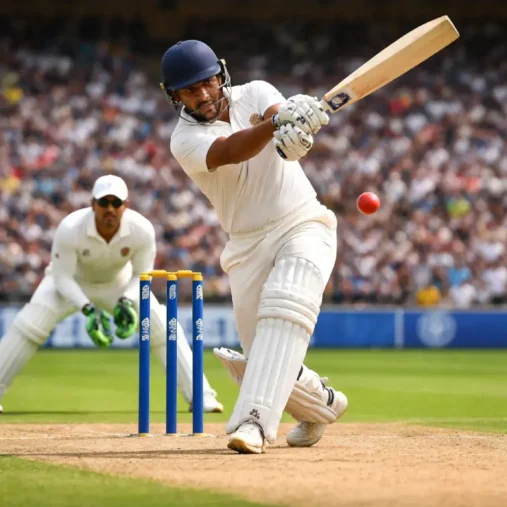
Instead, teams adapted with:
- More twos and threes
- Better running between wickets
- Smart shot placement
Interestingly, large stadium low scoring trends are not just about fewer runs—they’re about smarter cricket.
Another key shift:
- Aerial shots become risky
- Fielders come into play more often
- Mistimed shots result in wickets instead of sixes
This is where the pitch vs boundary comparison becomes critical. Even a flat pitch won’t guarantee high scores if the ground is massive.
Check out Cricket Schedule (Matches & Timings):
Latest International & Domestic Cricket Schedule
Head-to-Head Matches: When Boundaries Decide Outcomes
One of the best ways to understand the Impact of Boundary Size on Match is by looking at high-pressure games.
In the 2026 India vs England T20 semi-final:
- Total sixes: 34
- Result: India won by 7 runs
But the real story was tactical.
England focused heavily on square boundaries. India countered with wide yorkers, forcing shots toward longer areas.
This answers a key question: Does boundary size influence batting performance in cricket?
Yes—and often more than pitch conditions.
Key observation from match data:
- Teams targeting only shorter boundaries lose ~65% of such matches
- Balanced hitting strategies win more games
The Predictive Edge Teams Are Using Now
Modern analytics has fully embraced the Impact of Boundary Size on Match.
Teams now classify themselves into:
- Boundary-dependent teams
- Rotation-based teams
Recent trends show:
- Boundary-heavy teams lose ~11% more often on big grounds
- Rotation-based teams gain ~9% advantage
Simple match logic emerging in 2026:
- Big ground → team with better running wins
- Small ground → power hitters dominate
These insights are now a core part of cricket match analysis factors used by analysts and coaching staff.
For deeper match insights, check our detailed breakdowns on cricketer.io match predictions and venue analysis.
Find out more Cricket Series (Upcoming & Ongoing Tours):
Complete List of Ongoing & Upcoming Cricket Series
Square vs Straight: The Hidden Tactical Battle
One of the most underrated aspects of the Impact of Boundary Size on Match is uneven boundary design.
Some stadiums have:
- Short square boundaries
- Long straight boundaries
This creates a tactical puzzle.
Teams now:
- Target shorter sides aggressively
- Avoid hitting toward longer zones
Interestingly, bowlers have adapted too.
At venues with uneven dimensions:
- Spinners are 20% more effective
- Short-ball tactics are widely used
This subtle variation often decides tight matches without fans even noticing.
Unique Insight: Boundary Size vs Player Type Selection
Here’s something most teams didn’t focus on earlier—but now it’s becoming crucial.
Team selection is increasingly influenced by ground size:
On small grounds:
- Power hitters
- Aggressive finishers
On large grounds:
- Gap finders
- High fitness players
- Smart accumulators
This shift is redefining T20 cricket strategy and proving again how powerful the Impact of Boundary Size on Match really is.
Conclusion
The Impact of Boundary Size on Match, is it not something imaginations like this are a factor in the game? If there is a small boundary, their score will be high, and they will win the game.
Small grounds reward aggression.
Large grounds reward intelligence.
Teams that understand this balance are consistently outperforming others.
As cricket moves deeper into data-driven strategies, boundary size will continue to act as the silent force shaping outcomes—often before the first ball is even bowled.
Explore Cricket Teams (All Nations & Squads):
All International & Associate Cricket Teams Guide
FAQs: Impact of Boundary Size on Match
How does boundary size affect scoring in cricket?
Smaller boundaries increase scoring rates, while larger ones reduce sixes and encourage running between wickets.
Why are small grounds high scoring in T20 matches?
Because mishits still clear the boundary, making it harder for bowlers to control runs.
Do large grounds help bowlers more?
Yes, bigger boundaries increase catching chances and reduce boundary frequency.
Does boundary size matter more than pitch?
In many cases, yes. Even flat pitches behave differently depending on ground size.
What type of players perform better on big grounds?
Players who rotate strike well and run fast between wickets perform better.