
Last Updated: July 2026
Reading Time: 7 mins
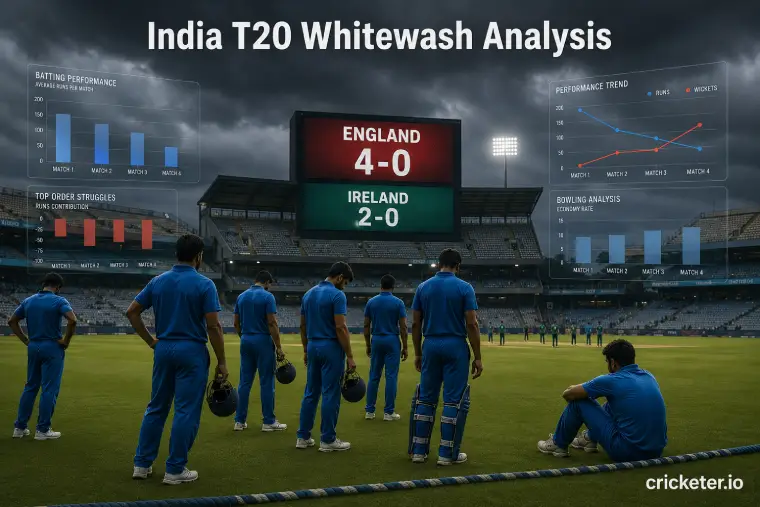
When IPL 2026 got over expectations from team India but just after that as soon as players entered in international cricket they exposed and no even able to get matches against Ireland that is considered as small team, and against England.
First came a historic 0-2 defeat against Ireland, India’s first bilateral T20I series loss to the Irish side. Before the team could recover, England completely outplayed team India to seal a 4-0 victory in the five-match T20I series, one match could not be played due to rain else it would be 5-0.
Naturally, one question is now dominating discussions among cricket fans.
Who is actually responsible?
Is Gautam Gambhir’s coaching under pressure? Have IPL pitches created batters who struggle overseas? Or did individual players simply fail to deliver when India needed them the most?
This India T20 Whitewash Analysis examines every major factor using match data, player performances and tactical trends rather than emotion.
Cricketer.io Intelligence Verdict
The answer is more complicated than blaming one coach or one player.
India’s defeats were created by a combination of three major factors:
- Overseas conditions exposed technical weaknesses.
- Several senior batters failed to convert starts.
- Bowling lacked consistency during both Powerplay and death overs.
Rather than one major failure, the numbers suggest a complete team breakdown.
Consecutive Overseas Series Losses
India entered both tours with tremendous confidence after a high-scoring IPL season.
The results told a completely different story.
| Series | Result |
|---|---|
| Ireland T20I Series | Lost 0-2 |
| England T20I Series | Lost 0-4 |
These back-to-back defeats immediately raised concerns about whether India’s current white-ball approach is sustainable outside familiar home conditions.
IPL Form vs Overseas Reality
IPL rewards fearless batting.
England and Ireland demand technical discipline.
That difference became obvious throughout both series.
India Batting Performance Across Three Competitions
| Player | IPL Runs | Ireland Runs | England Runs |
|---|---|---|---|
| Vaibhav Sooryavanshi | 776 | DNP | 42 |
| Abhishek Sharma | 563 | 49 | 131 |
| Ishan Kishan | 602 | 13 | 122 |
| Sanju Samson | 400 | 5 | 28 |
| Shreyas Iyer | 498 | 13 | 218 |
| Tilak Varma | 359 | 74 | 104 |
| Shivam Dube | 270 | 45 | 85 |
The numbers immediately reveal one important trend.
Only Shreyas Iyer, Abhishek Sharma and Tilak Varma managed to produce relatively consistent performances after leaving IPL conditions.
Several experienced players struggled badly against swing, seam movement and extra bounce.
Which Indian Batters Performed Best?
Shreyas Iyer Led From the Front
Shreyas Iyer finished as India’s highest run-scorer during the England series.
| Matches | Runs | Average | Strike Rate |
|---|---|---|---|
| 5 | 218 | 54.50 | 157.97 |
He adapted his game instead of relying only on power-hitting.
Unlike several teammates, he rotated strike effectively before attacking loose deliveries.
His innings of 80 and 68 showed that overseas success still comes through batting discipline rather than constant aggression.
Abhishek Sharma Still Looked Dangerous
Abhishek Sharma carried confidence from IPL into international cricket.
Although he wasn’t as dominant as during IPL 2026, he still managed:
- 131 runs
- Strike rate 177.03
- 16 fours
- 6 sixes
His attacking mindset remained intact, but better bowling plans limited his ability to play long innings.
Tilak Varma Continues to Impress
Among India’s younger batters, Tilak Varma probably adapted the fastest.
He scored:
- 74 runs against Ireland
- 104 runs against England
His unbeaten fifty in England demonstrated maturity that many experienced players failed to show.
Rather than chasing boundaries every over, Tilak adjusted according to conditions.
Which Batters Disappointed?
Ishan Kishan
Despite finishing with 122 runs in England, Ishan Kishan struggled badly in Ireland.
His inability to handle moving deliveries early in the innings prevented India from getting quick starts consistently.
Sanju Samson
Sanju Samson endured one of his toughest overseas tours.
Across both series he managed only 33 runs, despite arriving after another productive IPL season.
For one of India’s most experienced T20 batters, the numbers simply weren’t good enough.
Vaibhav Sooryavanshi
The youngster entered England with enormous expectations after scoring 776 IPL runs.
However, overseas cricket proved a completely different challenge.
His 42 runs in three innings showed that international cricket requires far more than clean ball striking.
The talent is obvious, but experience against quality seam bowling will take time.
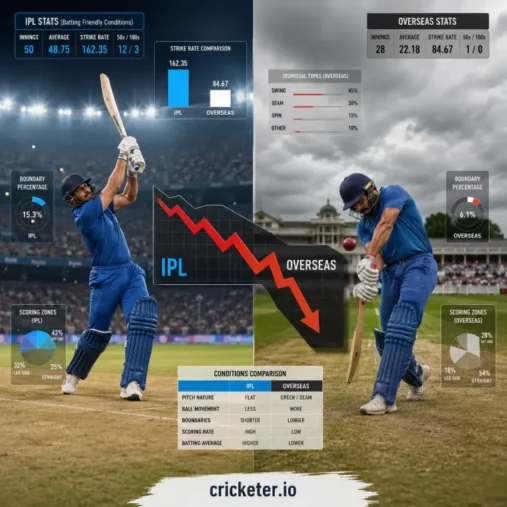
Did IPL Pitches Create False Confidence?
This has become one of the biggest debates after India’s overseas defeats.
IPL surfaces generally offer:
- Even bounce
- Flat wickets
- Smaller boundaries
- Limited lateral movement
England and Ireland offered exactly the opposite.
Batters suddenly faced:
- New-ball swing
- Consistent seam movement
- Extra bounce
- Larger outfields
- Better execution from fast bowlers
That transition exposed technical weaknesses that remained hidden during IPL 2026.
Rather than questioning IPL itself, the discussion should focus on whether Indian batters receive enough exposure to challenging conditions before overseas tours.
Did India’s Bowlers Let the Team Down?
Batting attracted most of the criticism, but India’s bowling attack also failed to control key phases of both series.
Against England, India repeatedly leaked boundaries during the Powerplay and death overs, allowing the hosts to dictate the tempo. The lack of wickets with the new ball meant England’s aggressive batters could attack without scoreboard pressure.
India Bowling Performance Against England
| Bowler | Matches | Wickets | Average | Economy |
|---|---|---|---|---|
| Arshdeep Singh | 5 | 4 | 37.50 | 9.47 |
| Harshit Rana | 3 | 3 | 23.33 | 10.00 |
| Prince Yadav | 3 | 2 | 59.00 | 10.73 |
| Axar Patel | 5 | 2 | 78.00 | 11.14 |
| Shivam Dube | 5 | 2 | 23.50 | 15.67 |
| Prasidh Krishna | 2 | 1 | 64.00 | 9.14 |
| Varun Chakaravarthy | 3 | 1 | 72.00 | 10.29 |
Only Arshdeep Singh managed more than three wickets across the series, but even he conceded nearly ten runs per over. Axar Patel, India’s most experienced spinner in the squad, finished with just two wickets while conceding more than eleven runs per over.
Those numbers underline why England regularly posted imposing totals.
Ireland Bowling Showed Promise but England Exposed the Gaps
Interestingly, India’s bowlers looked far more effective in Ireland.
India Bowling Performance Against Ireland
| Bowler | Matches | Wickets | Average | Economy |
|---|---|---|---|---|
| Harshit Rana | 2 | 4 | 10.25 | 5.86 |
| Arshdeep Singh | 2 | 4 | 15.75 | 7.88 |
| Prince Yadav | 1 | 3 | 7.33 | 5.50 |
| Shivam Dube | 2 | 3 | 14.33 | 7.17 |
| Axar Patel | 2 | 2 | 30.50 | 7.63 |
The contrast between the two tours is striking.
India’s bowling attack was disciplined against Ireland but struggled badly once England’s deeper batting lineup attacked relentlessly. This suggests the issue was not simply bowling quality but the inability to adapt against stronger opposition.
Is Gautam Gambhir Responsible?
Whenever India loses consecutive series, attention naturally turns towards the head coach.
However, blaming Gautam Gambhir alone ignores what the numbers actually show.
During his coaching tenure:
- India defeated Australia 2-1 in a T20I series in 2025.
- Several young players have been introduced into the national setup.
- The England and Ireland tours came during a major rebuilding phase with a relatively inexperienced batting group.
Coaches create strategies, but they cannot bat or bowl on the field.
Several dismissals during both series resulted from poor shot selection rather than tactical errors. Likewise, loose deliveries during crucial overs were execution mistakes, not coaching instructions.
The current results certainly increase pressure on the coaching staff, but the statistics do not support the argument that coaching alone caused the defeats.
Did IPL Pitches Play a Bigger Role?
One of the strongest talking points is whether IPL conditions prepared players adequately for overseas cricket.
The transition was dramatic:
| IPL Cricket | England & Ireland Cricket |
|---|---|
| Flat batting wickets | Swing and seam movement |
| Short boundaries | Bigger grounds |
| Predictable bounce | Variable bounce |
| High-scoring matches | Greater value for patience |
| Aggressive stroke play rewarded | Shot selection becomes critical |
Many batters who dominated IPL bowling struggled once they faced moving deliveries with little margin for error.
That does not mean the IPL is the problem. Instead, it highlights the need for better preparation before overseas tours, including practice on seam-friendly pitches and longer adaptation camps.
Also Read: IPL Stars Overseas Performances.
Who Should Take Responsibility?
The India T20 Whitewash Analysis suggests that responsibility should be shared rather than placed on one individual.
Coaching Group
The coaching staff deserves scrutiny for tactical decisions, bowling rotations, and match planning. More proactive adjustments could have reduced pressure during key moments.
Batters
Several senior players failed to convert starts into match-winning innings. Apart from Shreyas Iyer, no batter consistently controlled games across both tours.
Bowlers
India’s inability to contain England’s aggressive batting during the Powerplay and death overs proved equally damaging. Consistently conceding high economy rates made defending or chasing totals increasingly difficult.
Selectors
The selectors also face important decisions. Overseas tours demand players capable of adapting quickly rather than simply rewarding IPL form.
Cricketer.io Expert Insight
The biggest lesson from these two defeats is that overseas T20 cricket has evolved.
Raw power alone is no longer enough.
Teams like England have built batting line-ups capable of attacking while still respecting conditions. Their bowlers constantly adjust lengths, vary pace, and execute clear plans.
India still possesses exceptional talent, but future overseas success will depend on producing players who combine IPL aggression with strong defensive techniques against swing and seam bowling.
If these lessons are implemented now, the Ireland and England defeats could become valuable stepping stones rather than long-term setbacks.
Cricketer.io Intelligence Summary
| Category | Verdict |
|---|---|
| Biggest Positive | Shreyas Iyer’s consistency |
| Best Young Batter | Tilak Varma |
| Best Strike Rate | Abhishek Sharma |
| Biggest Concern | Top-order inconsistency |
| Bowling Weakness | Death overs and Powerplay control |
| Coaching Pressure | Moderate |
| Main Reason Behind Defeats | Combined tactical and execution failures |
Frequently Asked Questions
Why did India lose both T20I series?
India struggled with batting consistency, bowling execution, and adapting to overseas conditions.
Who scored the most runs for India against England?
Shreyas Iyer finished as India’s leading run-scorer with 218 runs.
Did IPL form translate into overseas success?
Only a few players carried their IPL form consistently into international cricket.
Is Gautam Gambhir solely responsible?
No. The defeats resulted from a combination of coaching, player execution, and difficult overseas conditions.
What is India’s biggest takeaway?
Preparing players for overseas conditions before major tours should become a higher priority.
Conclusion
Transistioning from IPL 2026 to International cricket series was really disappointing. Indian team could not even got a single match out of 7, India T20 Whitewash Analysis shows the real reason that shows defeats against Ireland and England exposed technical weaknesses, inconsistent batting, expensive bowling, and the challenges of transitioning from IPL cricket to international conditions.
These losses was a complete failure, they should be treated as an opportunity to rebuild with a stronger focus on adaptability. History has shown that India’s most successful overseas teams learned quickly from difficult tours. Whether this young group can do the same will define India’s white-ball future over the next few years.
Editorial Note: Match statistics and player performances are based on the completed Ireland and England T20I series through July 2026. Analysis and insights are independently prepared by Cricketer.io Intelligence using official match data and performance trends.