
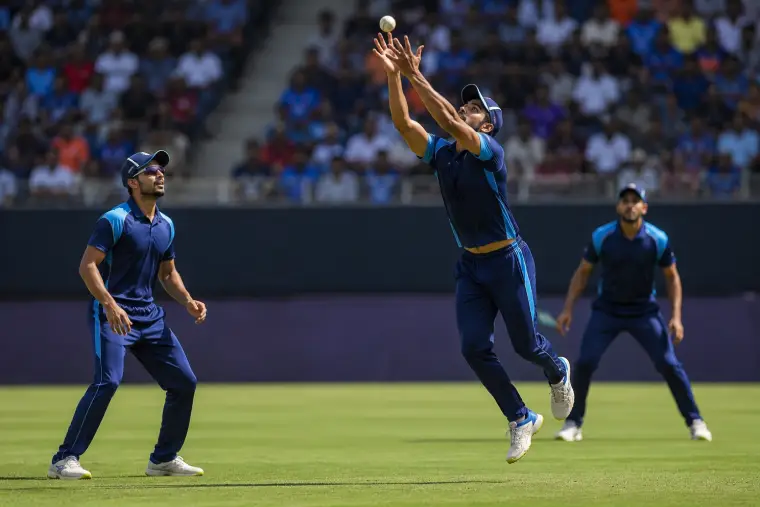
Fielders became a focus point, whether it’s about when a batter wants to get runs as many as possible, sometime agressively or under pressure. In such moments, the team places their best fielders where the batter is trying to get runs, this is where the most catches in T20I Cricket History were created by such fielders. That’s why a phrase “catches win matches”.
As of May 2026, South Africa’s DA Miller leads the chart for the Most Catches in T20I Cricket History with 86 catches in 139 innings. Afghanistan veteran Mohammad Nabi remains close behind with 82 catches, while UAE captain Muhammad Waseem has emerged as one of the fastest-rising fielders in world cricket.
The biggest shift in modern T20 cricket is how teams now value athleticism. One sharp catch in the powerplay or near the boundary can completely change the momentum. This could be the turning point that many fans ignore while discussing major T20 victories.
Where The T20I Fielding Race Stands
The competition for the Most Catches in T20I Cricket History has become more intense because players are featuring in more international matches every year.
Here are the updated all-time leaders till May 2026:
| Rank | Player | Span | Mat | Inns | Ct | Max | Ct/Inn |
|---|---|---|---|---|---|---|---|
| 1 | DA Miller (SA/World) | 2010-2026 | 140 | 139 | 86 | 4 | 0.618 |
| 2 | Mohammad Nabi (AFG) | 2010-2026 | 152 | 152 | 82 | 3 | 0.539 |
| 3 | Muhammad Waseem (UAE) | 2021-2026 | 99 | 99 | 76 | 3 | 0.767 |
| 4 | GH Dockrell (IRE) | 2010-2026 | 157 | 154 | 75 | 3 | 0.487 |
| 5 | S Muniandy (MAS) | 2019-2026 | 118 | 116 | 73 | 3 | 0.629 |
| 6 | MJ Guptill (NZ) | 2009-2022 | 122 | 121 | 68 | 3 | 0.561 |
| 7 | Babar Azam (PAK) | 2016-2026 | 145 | 144 | 68 | 3 | 0.472 |
| 8 | HT Tector (IRE) | 2019-2026 | 98 | 98 | 66 | 4 | 0.673 |
| 9 | TG Southee (NZ) | 2008-2024 | 126 | 124 | 65 | 2 | 0.524 |
| 10 | RG Sharma (IND) | 2007-2024 | 159 | 159 | 65 | 3 | 0.408 |
The latest rankings show how the Most Catches in T20I Cricket History is no longer dominated only by players from traditional cricket giants.
Ireland, UAE, Afghanistan, and Malaysia now have players competing strongly in global fielding records.
The debate around Most Catches by a Player in T20I Cricket has become more interesting because modern cricket rewards fielding consistency almost as much as batting or bowling.
What Happened In Recent ICC Events
Recent ICC tournaments again proved why fielding quality matters heavily in T20 cricket.
Several matches during ICC competitions in 2025 and 2026 changed entirely because of dropped catches or brilliant boundary saves. South Africa, New Zealand, and India consistently maintained high catching standards during pressure overs.

A key factor most fans ignore is how players chasing the Most Catches in T20I Cricket History now train specifically for relay catches, boundary awareness, and reverse-cup techniques.
Modern coaching staffs focus heavily on:
- Boundary rope positioning
- High-pressure catching drills
- Reaction catching
- Night-match fielding
- Diving recovery movements
This tactical preparation has transformed international fielding standards.
Tactical Shift Expected In Modern T20 Cricket
The tactical side of fielding has evolved rapidly.
Teams now analyze:
- Catch conversion percentage
- Boundary-saving efficiency
- Pressure-over fielding impact
- Catch success under lights
- Reaction speed inside the circle
This explains why Top Fielders With Most Catches in T20 Internationals are becoming more valuable every season.
The race for the Most Catches in T20I Cricket History is now strongly connected to fitness, anticipation, and positioning.
Players like DA Miller and Muhammad Waseem regularly patrol high-pressure catching zones because of their athletic movement and awareness.
Team Adjustments Driving Better Fielding
Several international teams have completely changed their selection strategies.
South Africa continues to rely heavily on experienced fielders during pressure situations. DA Miller’s consistency in deep-field positions has helped the team close several tight matches over the last few years.
Ireland has also benefited massively from GH Dockrell and HT Tector, who continue to improve their fielding numbers.
Afghanistan’s fielding structure has become more disciplined under Mohammad Nabi’s leadership and experience.
Former South Africa captain Faf du Plessis once said:
“Fielding pressure forces mistakes before bowlers even create them.”
That statement perfectly reflects the current race for the Most Catches in T20I Cricket History.
Also read: Most Dropped Catches in Cricket History
Probable XI Changes And Future Record Movers
Several active players could climb rapidly in the rankings over the next few seasons.
| Player | Current Catches | Long-Term Outlook |
| Muhammad Waseem | 76 | Strong chance to cross 100 quickly |
| HT Tector | 66 | Could become Ireland’s all-time leader |
| DA Miller | 86 | Favorite to extend overall record |
| Babar Azam | 68 | Still climbing steadily |
| S Muniandy | 73 | One of Asia’s underrated fielders |
The Highest Catches Record in T20I Cricket History could continue rising quickly because active players now play more T20 internationals every year.
This could become one of cricket’s most underrated statistical battles.
Pitch Conditions And Catching Difficulty
Pitch type directly affects fielding opportunities.
Fast surfaces usually create:
- Top-edge catches
- Deep-field chances
- Fast reaction opportunities
Slow pitches usually create:
- Mistimed lofted shots
- Sweeper-cover catches
- Boundary pressure moments
The Dew also changes, catching difficulty significantly during night games.
Several catches were dropped during ICC matches earlier this year because of heavy moisture under lights.
Key Battle To Watch In Upcoming Years
One fascinating trend in the Most Catches in T20I Cricket History race is the battle between experienced veterans and younger, athletic fielders.
Veterans dominate through anticipation and positioning.
Young fielders dominate through speed and aggressive boundary movement.
This balance explains why Players With the Most Catches in ICC T20I Matches now come from very different cricket systems.
DA Miller represents calm positional excellence.
Muhammad Waseem represents modern athletic fielding.
HT Tector represents consistency.
Mohammad Nabi represents experience and awareness.
Prediction: Who Could Finish With The Most Catches Ever?
DA Miller currently looks the favorite to remain at the top of the Most Catches in T20I Cricket History rankings for the next few years.
However, Muhammad Waseem is emerging as a serious long-term challenger because of his outstanding catch-per-innings ratio.
His 0.767 catches per innings is currently one of the strongest numbers in world cricket.
HT Tector could also rise rapidly if Ireland continues expanding their international T20 schedule.
The Best Fielders in T20I Cricket are no longer judged only through spectacular catches.
Teams now evaluate:
- Catch conversion rates
- Boundary-saving ability
- Throwing accuracy
- Pressure-over-performance
- Misfield prevention
Series Impact On Modern Cricket
The increasing importance of fielding is changing talent scouting across international cricket.
Several franchise leagues now prioritize athletic fielders even if their batting numbers are slightly lower.
The T20I Fielding Records of the next decade could increase rapidly because players are fitter, younger, and more specialized.
The Most Successful Catchers in Cricket are now often players contributing in every department.
Another important trend is the rise of specialist boundary fielders.
Teams now use analytics to identify the safest zones for specific players.
That level of planning barely existed a decade ago.
Modern ICC Events And Catching Trends
Recent ICC tournaments produced several memorable fielding performances.
The Most Catches in ICC T20 World Cup charts are increasingly dominated by boundary riders instead of traditional infield catchers.
Modern T20 Cricket Fielding Statistics show dropped catches during death overs often decide knockout matches.
South Africa, New Zealand, and Afghanistan have shown impressive catching consistency during pressure situations recently.
The Greatest Fielders in Cricket History continue influencing the next generation.
Legends like Jonty Rhodes, AB de Villiers, Ravindra Jadeja, and Glenn Maxwell changed expectations around athletic fielding.
The discussion around Most Catches by Non-Wicketkeepers in T20Is has also become more important because teams heavily rely on specialist outfield catchers.
Final Verdict
It’s a race where most catches in T20 cricket history are becoming competitive in each season. They change the complete momentum of the complete game; sometimes, a 1 drop catch helps the other team to get the game.
DA Miller currently leads the chart with 86 catches, but challengers like Mohammad Nabi, Muhammad Waseem, and HT Tector continue to close the gap.
The biggest lesson from recent tournaments is simple: elite fielding now decides modern T20 cricket.
Teams winning ICC trophies are almost always among the strongest catching sides.
That trend is likely to become even stronger over the next decade.
FAQs
Who has the most catches in T20I cricket history?
DA Miller (SA/World) holds the record for the most catches in T20I cricket history with 86 catches till May 2026.
Which player has the best catches-per-inning ratio among the top fielders?
Muhammad Waseem has one of the best catch-per-innings ratios with 0.767.
Why is fielding becoming more important in T20 cricket?
Modern T20 matches are often decided by one or two moments, making catches extremely valuable.